

concentration polarization in Seawater RO
Concentration polarization is a common transport phenomenon in seawater reverse osmosis (SWRO) systems. It occurs when rejected salts and other dissolved substances become more concentrated near the surface of the RO membrane than in the main body of the feedwater.
This may sound like a small difference, but it can have a practical effect on membrane performance. The higher concentration near the membrane surface increases local osmotic pressure and reduces the effective driving force for water transport.
For engineers operating or designing Seawater Desalination Equipment, understanding concentration polarization helps explain why membrane flux, recovery, feed flow, and salt rejection can change even when the equipment itself has not been modified.
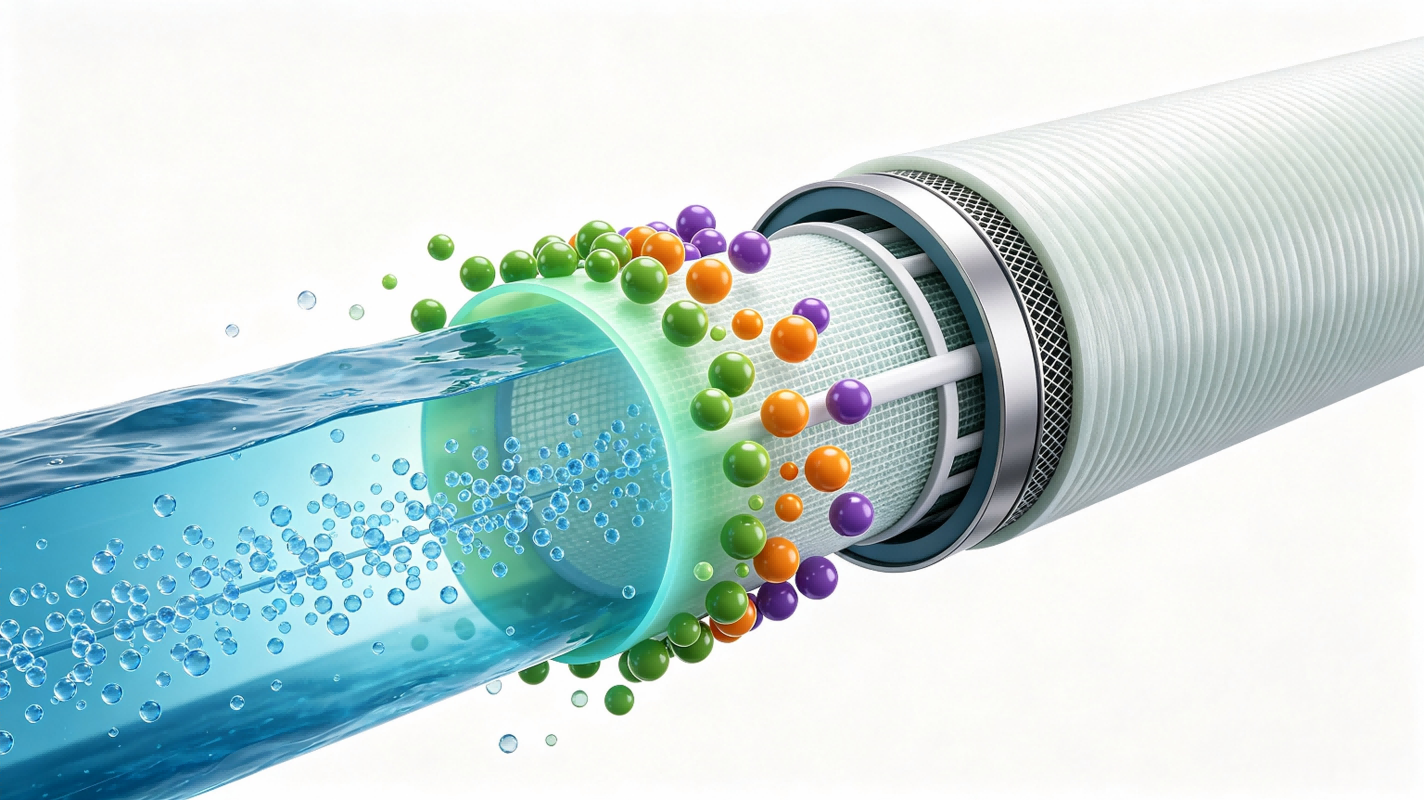
In an SWRO system, seawater is pushed across the membrane under high pressure. Water molecules can pass through the semipermeable membrane, while most dissolved salts are rejected.
As water permeates through the membrane, the salts that cannot pass through remain in the feed channel.
This creates a concentration gradient.
The bulk seawater may have a certain salt concentration, while the water immediately next to the membrane surface can have a higher concentration. The thin region where this concentration difference develops is commonly described as the concentration polarization layer or concentration boundary layer.
A simplified process can be understood as:
Bulk Seawater → Concentration Boundary Layer → RO Membrane → Permeate
The membrane rejects most dissolved salts, while water moves toward the permeate side. Because salts are retained, their concentration near the membrane surface can increase.
This is different from membrane fouling.
Concentration polarization is primarily a mass-transfer phenomenon. Fouling involves the physical accumulation or attachment of materials on the membrane surface. However, persistent concentration polarization can contribute to conditions that increase fouling or scaling risks.
The main cause is the difference between water transport and salt transport.
Water is continuously removed through the membrane, but rejected salts cannot cross the membrane at the same rate. As a result, salts tend to accumulate near the membrane surface.
At the same time, the feedwater is flowing parallel to the membrane surface. This flow helps move concentrated water away from the membrane and replace it with lower-concentration bulk feedwater.
The final concentration near the membrane therefore depends on the balance between:
Water permeation
Salt rejection
Feedwater flow
Mass transfer
Membrane flux
Feedwater salinity
Recovery
Channel geometry
If water flux becomes high while cross-flow is insufficient to remove accumulated salts, the concentration near the membrane surface can increase.
This is why hydraulic conditions are an important part of SWRO membrane design.
One of the most important consequences of concentration polarization is the increase in local osmotic pressure.
RO membranes work because the applied hydraulic pressure is greater than the osmotic pressure opposing water movement.
When the salt concentration immediately next to the membrane increases, the local osmotic pressure also increases.
The effective driving force for permeation is therefore reduced.
In simple terms:
Higher membrane-surface concentration → Higher local osmotic pressure → Lower effective driving force
If other conditions remain unchanged, this can reduce water flux.
This effect becomes particularly important when treating seawater because seawater already has a relatively high salt concentration compared with freshwater sources.
Feedwater salinity has a direct relationship with concentration polarization.
When the incoming seawater contains more dissolved salts, the concentration at the membrane surface can also become higher under comparable operating conditions.
This increases osmotic pressure and makes water transport more difficult.
For this reason, SWRO systems treating seawater with different salinity levels may require different operating pressures and membrane configurations.
For example, an SWRO system designed for typical coastal seawater may not be directly suitable for highly saline water without reviewing the membrane selection, operating pressure, recovery, and overall process design.
The feedwater analysis should therefore be completed before selecting the membrane array and operating conditions.
Feed flow is another important factor.
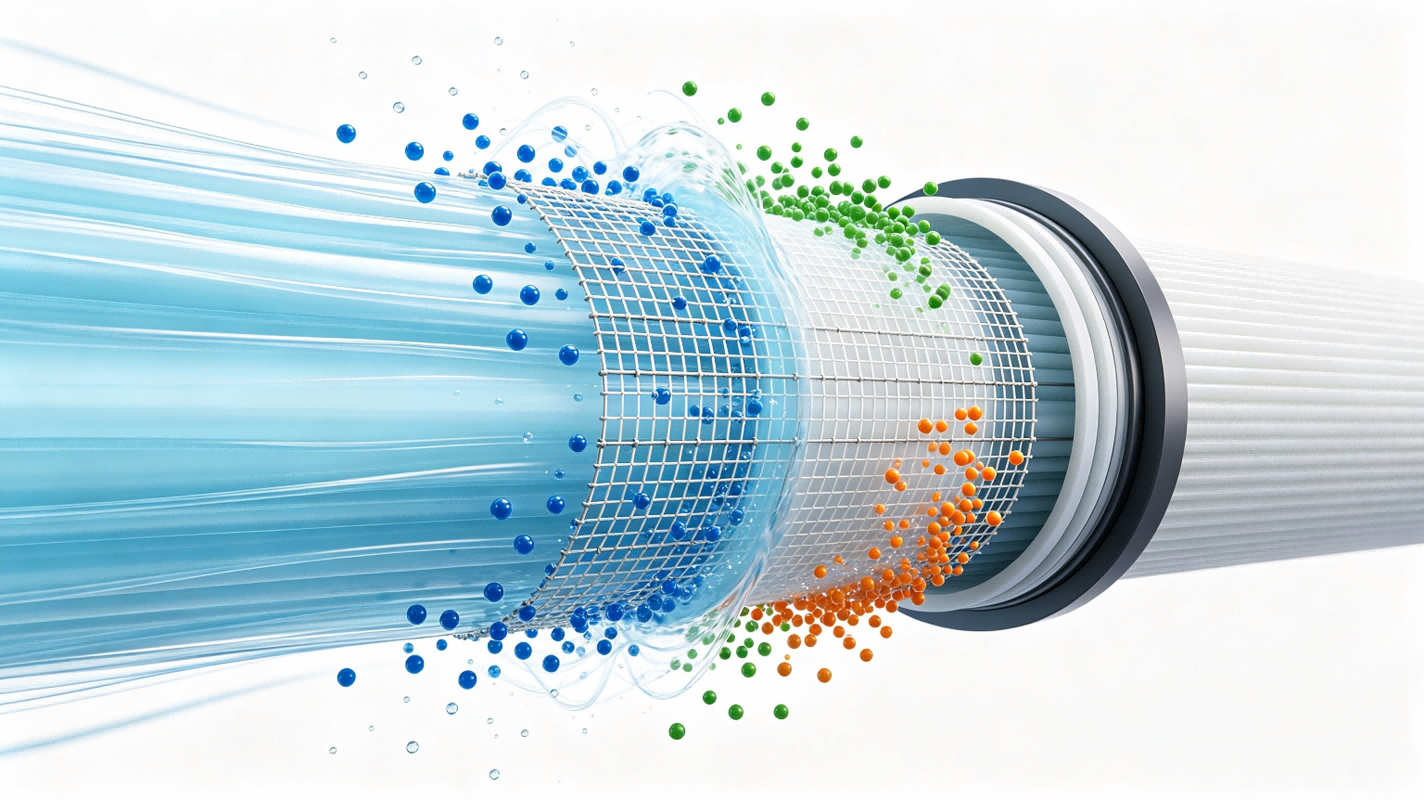
A higher cross-flow velocity can improve mass transfer near the membrane surface by carrying concentrated water away from the membrane and continuously supplying fresh feedwater.
When feed flow is too low, the concentration boundary layer can become more pronounced.
This does not mean that increasing feed flow without limits is always beneficial. Higher flow requires more pumping energy and can increase pressure losses through the membrane channel and piping system.
The practical objective is to maintain suitable hydraulic conditions within the membrane manufacturer's recommended operating range.
This is one reason SWRO membrane arrays are designed with specific vessel arrangements, element counts, flow rates, and pressure conditions.
Membrane flux describes the amount of permeate produced per unit membrane area over a given period.
When flux increases, more water is being removed from the feed channel through the membrane.
If the cross-flow conditions do not increase proportionally, the concentration near the membrane surface can rise.
This creates an important engineering balance.
Very high flux may provide greater permeate production from a given membrane area, but it can also increase the concentration polarization effect and place greater demands on membrane operation.
A practical SWRO design therefore does not simply attempt to maximize flux.
Instead, engineers consider membrane area, feed flow, pressure, recovery, salinity, temperature, and water quality together.
Concentration polarization can become more noticeable as seawater travels through the RO membrane system.
At the inlet, the feedwater has its original salinity and relatively high flow.
As water is removed through the membrane, the remaining concentrate becomes progressively more concentrated.
The result is a changing operating environment from the feed end to the concentrate end.
A simplified flow path looks like this:
Seawater Feed
↓
RO Membrane Inlet
↓
Increasing Salt Concentration
↓
Higher Local Osmotic Pressure
↓
Concentrate Outlet
This is one reason membrane elements are installed in series inside pressure vessels. The system needs to account for changing flow and concentration conditions as seawater passes through the membrane array.
Recovery is the percentage of feedwater converted into permeate.
Increasing recovery means more water is removed from the feed stream, leaving a smaller volume of increasingly concentrated brine.
For example, if 100 m³ of seawater enters an RO system and 40 m³ becomes permeate, the recovery is 40%.
The remaining 60 m³ contains most of the rejected salts.
As recovery increases, concentrate salinity increases. The higher concentration can increase osmotic pressure and contribute to stronger concentration polarization conditions.
Therefore, a higher recovery target needs to be evaluated together with membrane flux, feedwater chemistry, scaling potential, and operating pressure.
There is no single recovery value suitable for every Seawater Desalination project.
The feed spacer inside a spiral-wound RO membrane element plays an important role in water flow and mass transfer.
It creates a channel between membrane surfaces, allowing feedwater to move across the membrane rather than simply flowing through a narrow, unobstructed gap.
The geometry of the spacer influences:
Flow distribution
Mixing
Pressure drop
Mass transfer
Concentration polarization
Fouling behavior
A spacer that promotes stronger mixing can improve mass transfer near the membrane surface. However, more aggressive flow mixing can also increase pressure loss.
The spacer design therefore represents another engineering trade-off between membrane performance and energy requirements.
These two terms are sometimes confused, but they describe different phenomena.
Concentration polarization is associated with a concentration gradient near the membrane surface. It is strongly related to operating conditions and can change when feed flow, flux, salinity, or recovery changes.
Membrane fouling involves the accumulation of substances on the membrane surface or within the feed channel. Depending on the feedwater, fouling may involve suspended solids, microorganisms, organic compounds, or other contaminants.
Concentration polarization can create a local environment that is more favorable to scaling or fouling, so the two phenomena can interact.
However, reducing concentration polarization does not automatically remove existing membrane fouling.
This distinction is useful when diagnosing changes in SWRO performance.
Scaling is another concern when the concentration of certain dissolved minerals increases near the membrane surface.
As water passes through the membrane, dissolved substances are retained in the feed channel. If the local concentration approaches or exceeds the solubility limit of a mineral, precipitation may occur.
This can lead to scale formation on the membrane surface.
Common mineral scaling concerns in RO systems depend on the specific feedwater chemistry and may involve compounds containing calcium, carbonate, sulfate, silica, and other constituents.
For this reason, a seawater analysis should be performed during system design.
Depending on the water chemistry and operating conditions, pretreatment and antiscalant dosing may be used to manage scaling risk.
Pretreatment does not directly eliminate concentration polarization, but it plays an important supporting role in maintaining stable RO operation.
Effective pretreatment reduces suspended solids, microorganisms, colloids, and other contaminants that could contribute to membrane fouling.
Typical seawater pretreatment processes can include:
Intake screening
Coagulation
Clarification
Multimedia filtration
Ultrafiltration
Microfiltration
Cartridge filtration
Chemical dosing
The actual process should be selected according to the seawater source and feedwater quality.
A well-designed pretreatment system helps maintain stable membrane conditions, making it easier to control concentration polarization and distinguish hydraulic effects from fouling-related performance changes.
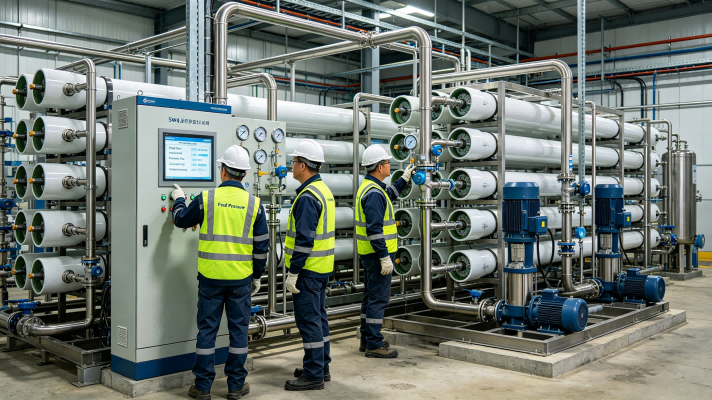
Concentration polarization is not normally measured using one simple field instrument.
Instead, operators monitor process parameters that provide information about membrane operating conditions.
Useful parameters include:
Feedwater conductivity
Feedwater temperature
Feed pressure
Permeate flow
Concentrate flow
Permeate conductivity
Differential pressure
Recovery rate
Changes in these parameters can help identify whether the membrane system is operating within its expected range.
For example, if permeate flow declines while feedwater temperature and pressure remain stable, operators may investigate fouling, scaling, or hydraulic changes.
If feedwater salinity or recovery has increased at the same time, the change in membrane performance may also be related to increased osmotic pressure and concentration polarization.
Trend monitoring is therefore more useful than relying on a single operating value.
There is no universal method for eliminating concentration polarization because some degree of concentration gradient naturally occurs in membrane separation.
The objective is to control it within a range compatible with stable membrane operation.
Several engineering measures can help:
Appropriate cross-flow helps transport concentrated water away from the membrane surface.
Avoiding unnecessarily high flux can reduce the rate at which water is removed from the feed channel and help maintain more manageable concentration conditions.
Recovery should be selected according to feedwater chemistry, membrane characteristics, and the desired production rate.
Membrane elements should be operated within the flow conditions recommended by the membrane manufacturer.
Reducing fouling and scaling contributors supports stable hydraulic and mass-transfer conditions.
Continuous monitoring of pressure, flow, conductivity, temperature, and recovery can help identify changes before they develop into larger operating problems.
When designing seawater Desalination Equipment, concentration polarization should be considered together with the complete membrane process.
The design engineer may need to evaluate:
Feedwater salinity
Target production
Membrane flux
Recovery
Feed flow
Pressure
Membrane area
Number of pressure vessels
Stage configuration
Spacer characteristics
Pretreatment
Scaling potential
These parameters are interconnected.
For example, increasing production without increasing membrane area may increase flux. Increasing recovery may increase concentrate salinity. Reducing feed flow may reduce energy consumption in some parts of the system but can also affect mass transfer.
A suitable design therefore requires a balance rather than optimization of one parameter in isolation.
Concentration polarization is a fundamental phenomenon in seawater reverse osmosis. It occurs because water passes through the membrane while most dissolved salts are rejected, creating a higher concentration near the membrane surface.
The resulting increase in local osmotic pressure can reduce the effective driving force for water transport and influence membrane flux.
Feed flow, membrane flux, seawater salinity, temperature, recovery, spacer design, and membrane configuration all affect the severity of concentration polarization.
For SWRO systems, the practical approach is to manage these factors together. Proper membrane array design, suitable operating conditions, effective pretreatment, appropriate recovery, and continuous process monitoring can help maintain stable membrane performance.
Understanding concentration polarization also makes it easier to interpret changes in permeate flow and pressure during daily operation. Instead of treating every production change as a membrane problem, engineers can evaluate the relationship between water chemistry, hydraulic conditions, and membrane transport to identify the actual operating cause.
Ce site Web utilise des cookies pour vous garantir la meilleure expérience sur notre site Web.
 English
 Portugues
 Pусский
 العربية
 ไทย
ไทย Indonesia
 Melayu
 Tiếng Việt
 中文
中文 қазақ
қазақ עִברִית
 မြန်မာ
 ພາສາລາວ
 Filipino
 o'zbek
 Кыргызча
 тоҷикӣ
 ខ្មែរ
ខ្មែរ Türkmenler



 Téléphone
Commentaire
(0)